
Off and on again
In the film Jurassic Park, Nedry (Wayne Knight) infects the park’s computer network with a worm so that he can steal dinosaur embryos and escape from the island. Chaos ensues, and Arnold (Samuel L. Jackson) chainsmokes through the night to get the network back online. He is unsuccessful, and figures that the only way to restore the security system is to reboot the whole network.
Reboot the system
For as long as we have had computers, we have encountered errors and had to restart the machines to fix them. The key combination “CTRL-ALT-DEL” was one of the first things I learned about our family computer. The arbitrary combination of keys felt like a secret code from a video game, and indeed it was mostly invoked to shut down misbehaving games. Of course, sometimes the keyboard could freeze along with the computer, necessitating a hard reboot: reaching behind the machine to flick the power switch off and on again.
It’s not just personal computers: if the volume button on your TV isn’t working, you might turn it off and on again. A: “Uh oh, the internet’s not working!” B: “Try turning the router off.” Even a flickering lightbulb can be calmed by turning it off and on again. The problem is that the device is in an unpredictable state; the solution is to revert it to a predictable one.
“Have you tried turning it off and on again?” is a punchline in The IT Crowd. The joke is that people are often too lazy to realise how simple it is to fix a problem. But isn’t it surprising that some problems are so easily fixed? As a problem-solving rule of thumb, turning things off and on again seems unreasonably effective.
Reboot the brain
“The unreasonable effectiveness of _____” has become a meme; it was coined by a physicist to praise mathematics, and has lately been used by computer scientists to praise data and RNNs. As I began to write this essay, I wondered if anyone else had used the phrase before to describe rebooting. Someone has: the brilliant and thoughtful Keunwoo Choi, in his essay “On rebooting”. He explains why this troubleshooting technique is inevitable in computing, and can be deduced from first principles.
But the technique seems fundamental in other domains, too: think of how, when trying to solve a challenging puzzle (like a cryptic clue or a brain teaser), relaxing and taking one’s mind off the puzzle can precipitate a solution. We have several phrases to capture this feeling: pop science dubs it the “shower effect”. Bathtubs predate showers, and the “eureka effect”, referring to an historic bathtub event, ought to be the preferred term. Departing the bathroom, we speak of “l’esprit de l’escalier”, when a witty retort comes too late.
Clearly, we recognise the value of taking one’s mind off of a problem. What about turning the mind off and on altogether — i.e., sleeping? Doctors describe sleep as when “the brain resets itself”, and sleep seems to help with problem-solving even more than showers, baths and staircases. The titles of various sleep studies tell us that “A brief nap is beneficial for human route-learning”, that “After being challenged by a video game problem, sleep increases the chance to solve it”, and that, more succinctly: “Sleep inspires insight”.
Back in Jurassic Park, maybe Arnold should have been sleeping instead of chainsmoking. Or, he might have solved both problems — the computer worm and his smoking habit — by taking magic mushrooms. In the past decade, there has been a resurgence of research into psylocibin and its therapeutic potential to combat depression and addiction. Why does it work? In the words of Nature’s newsroom: “psylocibin resets neural networks”. They are summarising a paper that doesn’t actually use the words ‘reset’ or ‘reboot’, but it does report that “Psylocibin massively disrupted functional connectivity”, a change “driven by brain desynchronization across spatial scales […] which dissolved network distinctions by reducing correlations within and anticorrelations between networks.” Disrupting a network by desynchronising and dissolving a network — that sounds about as close as you can get to “rebooting” a network without turning the brain completely off.
Reboot the heart
There’s another organ that sometimes needs to be restarted when things go wrong: the heart. The job of the heart is to pump blood around the body. Doing so requires not just action — a squeeze to push the blood from here to there — but synchrony: the many muscles and valves in the heart need to squeeze and relax in a carefully timed sequence in order to pump effectively. The sequence is normally led by the natural pacemaker, a muscle that generates spontaneous impulses that cascade through the heart. When the rhythm is lost — e.g., if the pacemaker’s impulses arrive too rapidly, or the cascade flows incorrectly — the result is cardiac arrhythmia, and it is not easy for the separate muscles to find the rhythm again. What to do?
Clear!
A defibrillator sends a huge electric shock across the chest. For a brief moment, the many parts of the heart, which had been contracting chaotically, are all quieted. Now the natural pacemaker sends its next impulse, and all the other parts can follow the leader again. Per Wikipedia: “Defibrillation halts chaotic cardiac activity by forcibly depolarizing heart cells, disrupting re-entrant circuits, and allowing for the heart’s natural pacemaker to take over.” Like with the crashed computer, the problem is that the heart is in an unpredictable state; the solution is to revert it to a predictable one.
Resetting a heart may sound like a complex medical procedure, but it isn’t brain surgery; the intervention is straightforward enough that it can be programmed into a device with an instruction manual that is just 46 words long (which is the exact length of this paragraph).
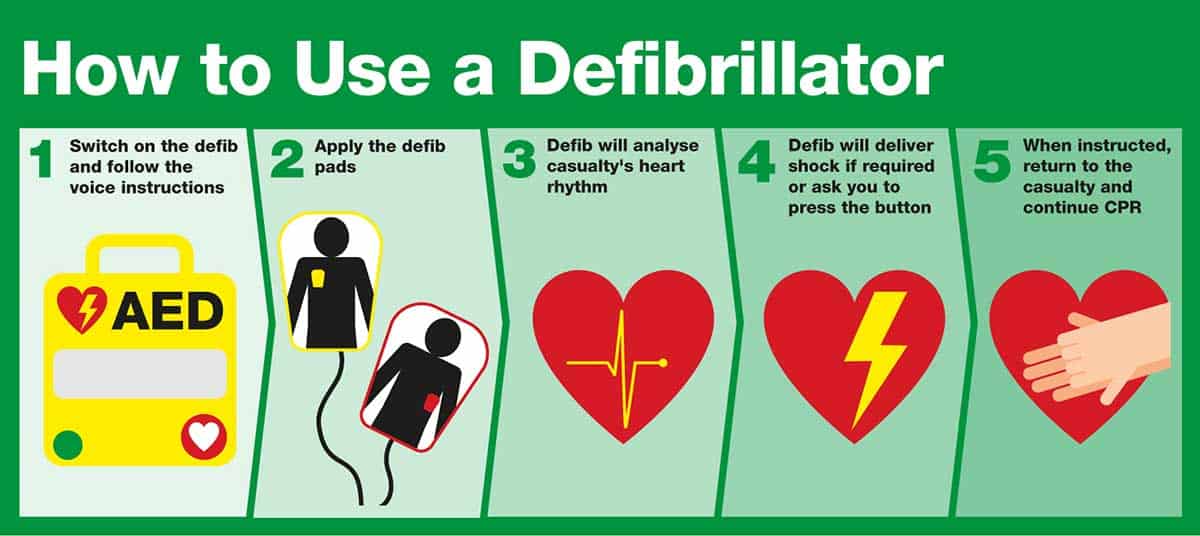
To be clear, a defibrillator is not turning the heart off and on again: when a heart has flatlined and is truly “off”, a defibrillator cannot turn it back “on”. In this case, the remedy is CPR. As it happens, this technique is also depicted in Jurassic Park: just when the park systems are being manually restarted, Tim, the younger grandchild, is climbing down an electrical fence. He gets a terrible zap — an unwanted defibrillation — but Dr. Alan Grant is able to resuscitate him using CPR.
Reboot the franchise
The heart, the brain, the mind, the computer — all valuable devices we can fix by turning them off and on again. What about film franchises? Jurassic Park went on to gross over $1B globally, but its sequel earned $618M, and Jurassic Park III earned $368M — diminishing returns that placed the franchise in danger. After a period of rest, the series was rebooted with Jurassic World, featuring a cleaned-up park and a fresh cast of characters, all put into place for the familiar mayhem to unfold like clockwork. The film restored the franchise to good financial health with a $1.6B haul, and a better critical reception than the previous sequels. But the sequels it spawned petered off again: they earned $1.3B and $1B each, and the worst reviews of the franchise. The series was re-rebooted last year, to middling reviews and $870M.
The filmmakers could always reboot the series again, but should they? Sometimes a device is in an unpredictable state, and the solution is to revert it to a predictable one. Other times, the device is obsolete, and the solution is to discard it.